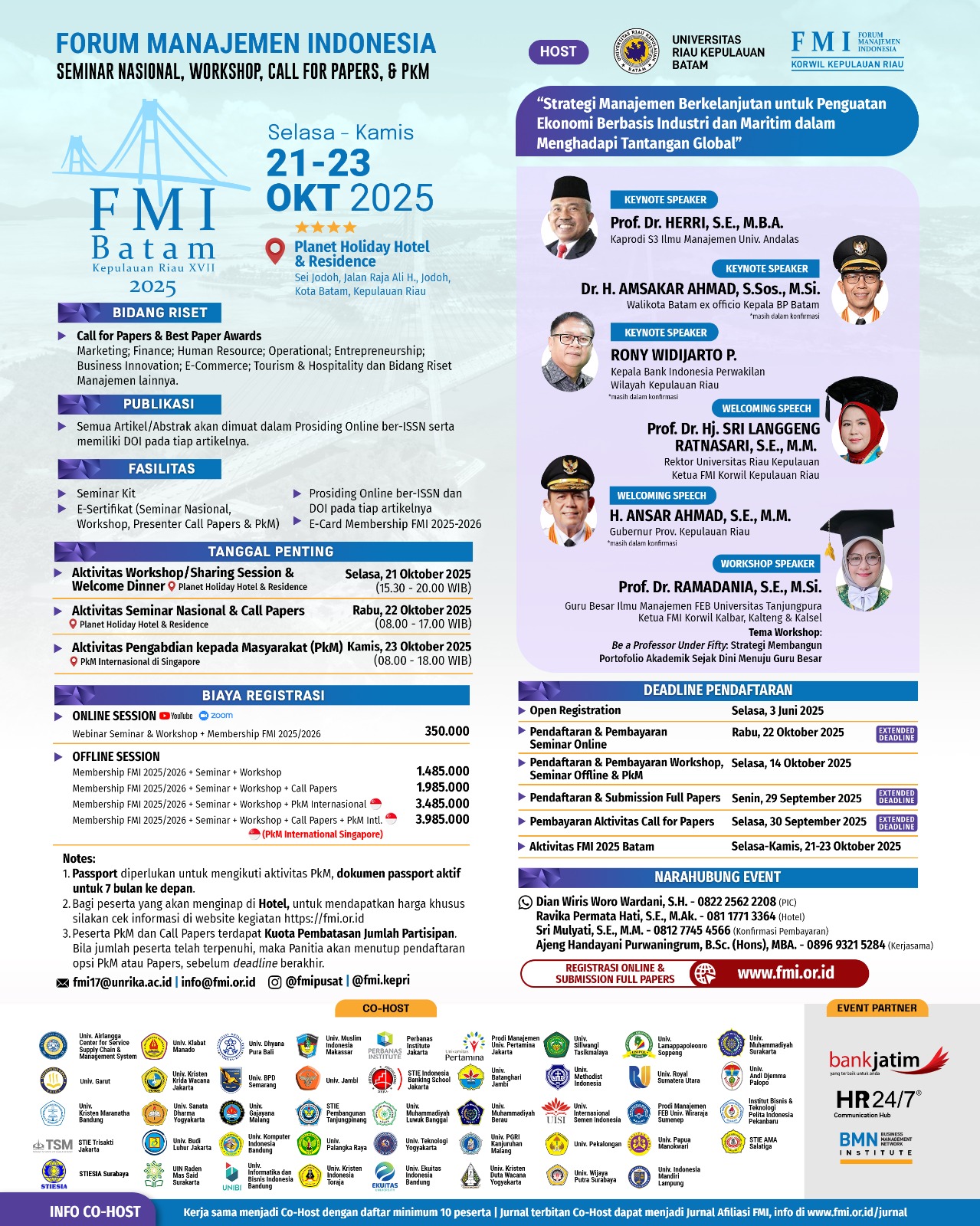
The Role of Innovative Work Behavior as a Mediator of the Effect of Hard Skill Training on the Sustainable Performance of Small and Medium Enterprises
DOI:
https://doi.org/10.47747/snfmi.v3i1.3131Abstract
The purpose of this study is to examine the effect of hard skill training on the performance of sustainable SMEs through the role of innovative work behavior. The population of this study was craft SME actors in Semarang Regency, with a saturated sample of 132 SME actors. Statistical data analysis was performed using the SPSS program. The results show that the hypothesis that hard skill training directly affects performance is rejected, but hard skill training affects innovative work behavior, which in turn affects performance. Based on the mediation test, it is proven that innovative work behavior can fully mediate the effect of innovative work behavior on SME performance. In other words, technical training effectively improves SME performance only through the formation of adaptive and creative innovative behavior. These results support SDG 4 (Quality education through technical skills training programs), SDG 9 (Innovation & Industry can encourage innovative behavior among MSME workers), and SDG 12, which is related to sustainable production and consumption. Future research should modify or add soft skills training variables as an effort to improve innovative behavior and sustainable MSME performance.
References
Anugrah, P. A., Malnava Sari, I., Wahyudin, U., & Sukmana, C. (2024). Palnning For SME Training and skill Program ti Improve The Local Economy in the Digital Era in Sukamulya Village. Jurnal Ilmiah Program Studi Pendidikan Luar Sekolah, 13. www.bi.go.id/id,
Ardhiyansyah, A., & Juniansyah, M. A. (2024). Have MSMEs in Indonesia Focused on Business Sustainability? The Influence of Environmental Orientation, Technology Implementation, Green Marketing, and Innovation Capability. Riset Ekonomi Manajemen), 7(2), 369–394.
Barile, S., Ciasullo, M. V., Testa, M., & La Sala, A. (2023). An integrated learning framework of corporate training system: a grounded theory approach. TQM Journal, 35(5). https://doi.org/10.1108/TQM-03-2022-0090
Barney, J. B., Ketchen, D. J., & Wright, M. (2011). The future of resource-based theory: Revitalization or decline? Journal of Management, 37(5). https://doi.org/10.1177/0149206310391805
De Jong, J., & Den Hartog, D. (2010). Measuring innovative work behaviour. Creativity and Innovation Management, 19(1). https://doi.org/10.1111/j.1467-8691.2010.00547.x
Fattah, A., 1, A., Wartini, S., Martono, S., & Soliha, E. (2025). The Role Of Innovation Capability in The Relationship Between Social Capital Enterpreunerial Leadership and MSME Performance in Semarang Culinary Sector. Management Analysis Journal, 14(2). http://maj.unnes.ac.id
Fitri, M. A., MDK, H., & Putri, I. D. (2023). Pengaruh Pelatihan Kerja Dan Kompensasi Terhadap Kinerja Pegawai Dinas Pemadam Kebakaran Dan Penyelamatan Kota Bengkulu. EKOMBIS REVIEW: Jurnal Ilmiah Ekonomi Dan Bisnis, 11(1). https://doi.org/10.37676/ekombis.v11i1.2912
Hasibuan, S. (2021). Manajemen Sumber Daya Manusia : pendekatan non sekuler,. Muhammadiyah University Press.
Hlasny, V. (2023). Vocational training support and innovation at SMEs. Asia Pacific Journal of Innovation and Entrepreneurship, 17(2). https://doi.org/10.1108/apjie-09-2022-0096
Holdford, D. A. (2018). Resource-based theory of competitive advantage – A framework for pharmacy practice innovation research. Pharmacy Practice, 16(3). https://doi.org/10.18549/PharmPract.2018.03.1351
Hughes, M., Rigtering, J. P. C., Covin, J. G., Bouncken, R. B., & Kraus, S. (2018). Innovative Behaviour, Trust and Perceived Workplace Performance. British Journal of Management, 29(4). https://doi.org/10.1111/1467-8551.12305
Irianto, J. (2022). Small and Medium Enterprise Development: Concept Overview of Stakeholder Engagement, Business Coaching, and the ADDIE Model in Training. JKMP (Jurnal Kebijakan Dan Manajemen Publik), 10(2). https://doi.org/10.21070/jkmp.v10i2.1690
Jalil, M. F., Ullah, W., & Ahmed, Z. (2021). Training Perception and Innovative Behavior of SME Employees: Examining the Mediating Effects of Firm Commitment. SAGE Open, 11(4). https://doi.org/10.1177/21582440211067250
Kable, J. W., Caulfield, M. K., Falcone, M., McConnell, M., Bernardo, L., Parthasarathi, T., Cooper, N., Ashare, R., Audrain-McGovern, J., Hornik, R., Diefenbach, P., Lee, F. J., & Lerman, C. (2022). Pengaruh Pelatihan dan Keterampilan Terhadap Percaya Diri yang Berdampak pada Kinerja Karyawan: JURNAL EMAS: Ekonomi Manajemen Akuntansi Kewirausahaan, 2(2).
Kmieciak, R. (2020). Trust, knowledge sharing, and innovative work behavior: empirical evidence from Poland. European Journal of Innovation Management. https://doi.org/10.1108/EJIM-04-2020-0134
Li, Q., Abdul Ghani Azmi, I. binti, & Norman, A. A. binti. (2025). Enhancing sustainable innovation through workplace well-being and digital capability: A systematic literature review toward responsible and cleaner consumption. Cleaner and Responsible Consumption, 18, 100305. https://doi.org/https://doi.org/10.1016/j.clrc.2025.100305
Mailani, D., Hulu, M. Z. T., Simamora, M. R., & Kesuma, S. A. (2024). Resource-Based View Theory to Achieve a Sustainable Competitive Advantage of the Firm: Systematic Literature Review. International Journal of Entrepreneurship and Sustainability Studies, 4(1), 1–15. https://doi.org/10.31098/ijeass.v4i1.2002
Noe, Raymond. A. (2017). Employee Training and Development (9th ed.). McGraw Hill.
Octasylva, A. R. P., Yuliati, L. N., Hartoyo, H., & Soehadi, A. W. (2022). Innovativeness as the Key to MSMEs’ Performances. Sustainability (Switzerland), 14(11). https://doi.org/10.3390/su14116429
Pramono, A. C., & Prahiawan, W. (2021). Effect Of Training On Employee Performance With Competence And Commitment As Intervening. APTISI Transactions on Management (ATM), 6(2). https://doi.org/10.33050/atm.v6i2.1742
Robbins, S. P. ., & Judge, Tim. (2019). Organizational behavior. Pearson.
Sari, F. A., & Amalia, L. (2022). Effectiveness of Training Methodology on Innovative Work Behavior and Government Employee Performance during the Covid-19 Pandemic: The Role of Soft Skill and Emotional Intelligence. Jurnal Manajemen Teori Dan Terapan | Journal of Theory and Applied Management, 15(1), 146–160. https://doi.org/10.20473/jmtt.v15i1.31486
Sari, S. A., & Ahmad, N. H. (2022). Connecting the Dots: Linking Entrepreneurial Leadership and Strategic Agility towards SME Competitiveness. Vision. https://doi.org/10.1177/09722629221091658
Sari, Y., Oktarina, Y., Munajat, & Kenamon, M. (2022). The Role of Innovation Capability in MSME Sustainability During the Covid-19 Pandemic. International Journal of Social Science and Business, 6(4). https://doi.org/10.23887/ijssb.v6i4.46158
Sutrisno, S., Permana, R. M., & Junaidi, A. (2023). Education and Training as a Means of Developing MSME Expertise. Journal of Contemporary Administration and Management (ADMAN), 1(3). https://doi.org/10.61100/adman.v1i3.62
Utomo, P., & Wartini, S. (2023). The Role Of Social Capital On Msme Performance Through Innovative Work Behavior. International Conferece Advance Tourism Management and Tecnology 1(1). https://doi.org/10.56910/ictmt.v1i1.148
Wijaya, E. (2023). The Contribution of Leadership and Innovative Work Behavior (IWB) on Performance and Organizational Trust as Mediation Variable : An Empirical Study on MSMEs. Journal of Industrial Engineering & Management Research, 4(1). https://doi.org/10.7777/jiemar.v2i5
Ying-Yu, K. C., Yi-Long, J., & Yu-Hsien, W. (2016). Effect of Digital Transformation on Organisational Performance of SMEs: Evidence from the Taiwanese Textile Industry’s Web Portal. In Internet Research (Vol. 26, Issue 1).