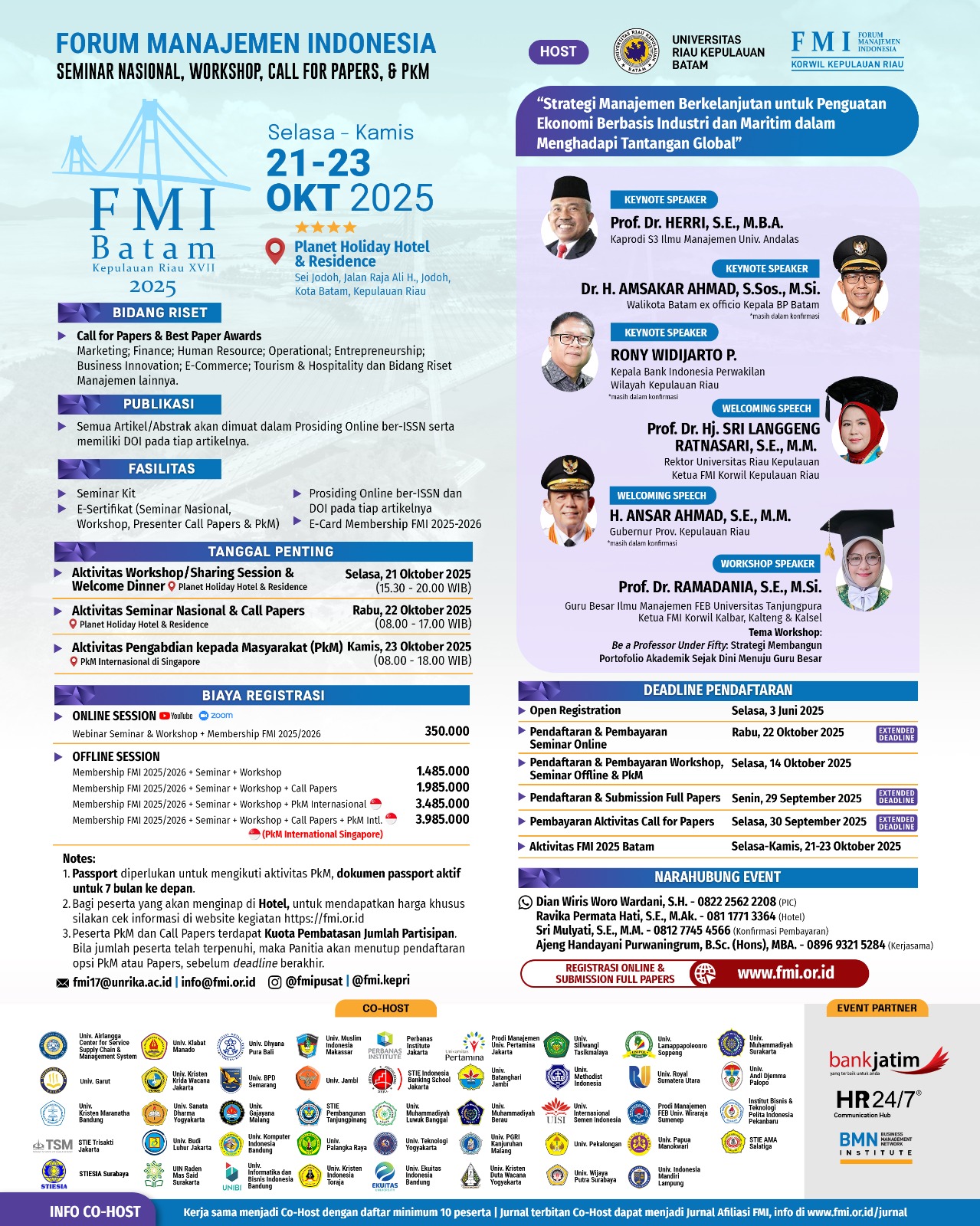
Micro and Small Enterprises, Climate Change Adaptation, and Mangrove-Based Resilience: Pathways to Achieving SDGs 8, 11, and 13 in Coastal Kendal, Indonesia
DOI:
https://doi.org/10.47747/snfmi.v3i1.3132Abstract
Micro and small enterprises (MSEs) are vital for local economies in developing countries but remain highly vulnerable to climate change, especially in coastal zones. This study investigates the adaptive capacity of MSEs in Kendal Regency, Central Java, Indonesia, a coastal area experiencing recurrent tidal flooding, land subsidence, and coastal erosion. Using a mixed-methods approach, survey data from 210 enterprises and interviews with 20 entrepreneurs were analyzed through partial least squares structural equation modeling (PLS-SEM) and thematic coding. The quantitative results indicate that access to finance, community collaboration, and entrepreneurial orientation each have a significant positive impact on adaptive capacity (H1–H3), while institutional Support enhances these relationships through moderating effects (H4–H6). Among these factors, access to finance emerged as the strongest predictor. The qualitative findings complement these results by illustrating three dominant adaptation strategies: pragmatic operational adjustments, diversification of business activities, and ecosystem-based adaptation through mangrove rehabilitation. However, gendered barriers persist, as women entrepreneurs reported more limited access to finance, community networks, and institutional recognition. By integrating quantitative and qualitative evidence, this study demonstrates that financial resources, collaboration, and entrepreneurship are necessary foundations for resilience, but their effectiveness depends on institutional facilitation. Policy implications include the need for gender-sensitive credit schemes, institutionalization of community collaboration, and recognition of entrepreneurial innovation. These findings highlight the role of coastal MSEs as both economic actors and agents of climate resilience, contributing to the achievement of SDG 8 (Decent Work and Economic Growth), SDG 11 (Sustainable Cities and Communities), and SDG 13 (Climate Action).
References
Abidin, H. Z., Andreas, H., Gumilar, I., Brinkman, J. J., & Fukuda, Y. (2011). Land subsidence in coastal city of Semarang (Indonesia): Characteristics, impacts and causes. Geomatics, Natural Hazards and Risk, 2(3), 233–250. https://doi.org/10.1080/19475705.2011.595436
Adger, W. N., Arnell, N. W., & Tompkins, E. L. (2005). Successful adaptation to climate change across scales. Global Environmental Change, 15(2), 77–86. https://doi.org/10.1016/j.gloenvcha.2004.12.005
Andrea, V., Gumilar, I., Abidin, H. Z., Sidiq, T. P., & Andreas, H. (2021). The impact of land subsidence on coastal areas in Semarang, Indonesia. Remote Sensing, 13(16), 3299. https://doi.org/10.3390/rs13163299
Anwar, S. U., Shah, S. A. R., Khan, R. A., & Qureshi, M. A. (2024). Green entrepreneurial orientation and environmental performance. Sustainability, 16(2), 568. https://doi.org/10.3390/su16020568
Arora-Jonsson, S. (2011). Virtue and vulnerability: Discourses on women, gender and climate change. Global Environmental Change, 21(2), 744–751. https://doi.org/10.1016/j.gloenvcha.2011.01.005
Becker, P., Revilla Diez, J., & Otto, A. (2025). Climate adaptation and small enterprises in Southeast Asia. Journal of Environmental Management, 345, 119403. https://doi.org/10.1016/j.jenvman.2024.119403
Braun, V., & Clarke, V. (2006). Using thematic analysis in psychology. Qualitative Research in Psychology, 3(2), 77–101. https://doi.org/10.1191/1478088706qp063oa
Chaussard, E., Amelung, F., Abidin, H., & Hong, S. H. (2013). Sinking cities in Indonesia: ALOS PALSAR detects rapid subsidence. Remote Sensing of Environment, 128, 150–161. https://doi.org/10.1016/j.rse.2012.10.015
Creswell, J. W., & Plano Clark, V. L. (2018). Designing and conducting mixed methods research (3rd ed.). Sage.
Dewi, R. G., Nurbani, A. T., Firdaus, H. S., & Avenzora, R. (2021). Vulnerability of SMEs to tidal flooding in Indonesia. Natural Hazards, 109(2), 1625–1647. https://doi.org/10.1007/s11069-021-04893-5
Djoudi, H., Locatelli, B., Vaast, C., Asher, K., Brockhaus, M., & Basnett Sijapati, B. (2016). Beyond dichotomies: Gender and intersecting inequalities in climate change studies. Ambio, 45(S3), 248–262. https://doi.org/10.1007/s13280-016-0825-2
Forino, G., von Meding, J., & Brewer, G. (2017). A conceptual governance framework for climate change adaptation and DRR. International Journal of Disaster Risk Reduction, 22, 381–387. https://doi.org/10.1016/j.ijdrr.2017.02.015
Gannon, K. E., Conway, D., Pardoe, J., & Vincent, K. (2022). Gender and climate adaptation: Evidence from small-scale enterprises. Climate and Development, 14(8), 683–695. https://doi.org/10.1080/17565529.2021.2005372
Gannon, K. E., Eskander, S. M. S. U., Avila-Uribe, A., et al. (2025). The role of gender in firm-level climate change adaptation behaviour: Insights from small businesses in Senegal and Kenya. (Artikel dalam proses publikasi)
Guetterman, T. C., Fetters, M. D., & Creswell, J. W. (2015). Integrating quantitative and qualitative results in mixed methods research. Methodological Innovations, 8(2), 1–23. https://doi.org/10.1177/2059799115589411
Gunawan, A. A., Bloemer, J., van Riel, A. C. R., & Essers, C. (2022). Institutional barriers for Indonesian SMEs. Sustainability, 14(14), 8772. https://doi.org/10.3390/su14148772
Intergovernmental Panel on Climate Change (IPCC). (2022). Climate Change 2022: Impacts, adaptation and vulnerability. Contribution of Working Group II to the Sixth Assessment Report of the IPCC. Cambridge University Press. https://doi.org/10.1017/9781009325844
Keys, N., Bussey, M., Carter, R. W., & Walshe, R. (2016). Adaptive capacity and climate change: The role of community opinion leaders in developing and mobilising stocks of adaptive capacity. Journal of Environmental Planning and Management, 49(1), 1–19. https://doi.org/10.1080/13549839.2014.967758
Lestari, D. S. T., & Purwanto, S. (2025). Blue Economy Financing: Sustainable Aquaculture in Indonesia. Quantitative Economics and Management Studies, 6(3), 446-455.
Linnenluecke, M. K., Griffiths, A., & Winn, M. (2012). Extreme weather events and organizational resilience. Business Strategy and the Environment, 21(1), 17–32. https://doi.org/10.1002/bse.708
Mortreux, C., de Campos, R. S., & O’Neill, S. (2021). Cultural political economy of risk in coastal zones. Global Environmental Change, 70, 102341. https://doi.org/10.1016/j.gloenvcha.2021.102341
Pongtanalert, K., & Assarut, N. (2022). Entrepreneur mindset, social capital and adaptive capacity for tourism SME resilience and transformation during the COVID-19 pandemic. Sustainability, 14(19), 12675. https://doi.org/10.3390/su141912675
Revilla Diez, J., Otto, A., & Becker, P. (2024). Collective adaptation of small enterprises in Vietnam. World Development, 169, 106235. https://doi.org/10.1016/j.worlddev.2023.106235
Shahidullah, A. K. M., Islam, M. T., & Khan, A. (2023). ‘Community-based adaptive entrepreneurship’ addressing the climate crisis: Experiences from the coastal zone. Journal of Cleaner Production, 391, 136–147. https://doi.org/10.1016/j.jclepro.2023.136147
Smit, B., & Wandel, J. (2006). Adaptation, adaptive capacity and vulnerability. Global Environmental Change, 16(3), 282–292. https://doi.org/10.1016/j.gloenvcha.2006.03.008
Trinh, T. A. (2022). Climate change and firm performance: Evidence from SMEs in Vietnam. World Development, 158, 105969. https://doi.org/10.1016/j.worlddev.2022.105969
United Nations Development Programme (UNDP). (2022). The principles for locally led adaptation: A call to action. UNDP. https://www.undp.org/publications/principles-locally-led-adaptation
Vinata, L. A. (2024). Blue carbon ecosystems for climate resilience in Indonesia. Environmental Policy and Law, 54(3–4), 323–333. https://doi.org/10.3233/EPL-230049
World Bank. (2023). Unlocking climate finance for resilience and adaptation. World Bank. https://openknowledge.worldbank.org/entities/publication/79e3e7f7-362a-4cf5-8aa9-05e3b4b87117