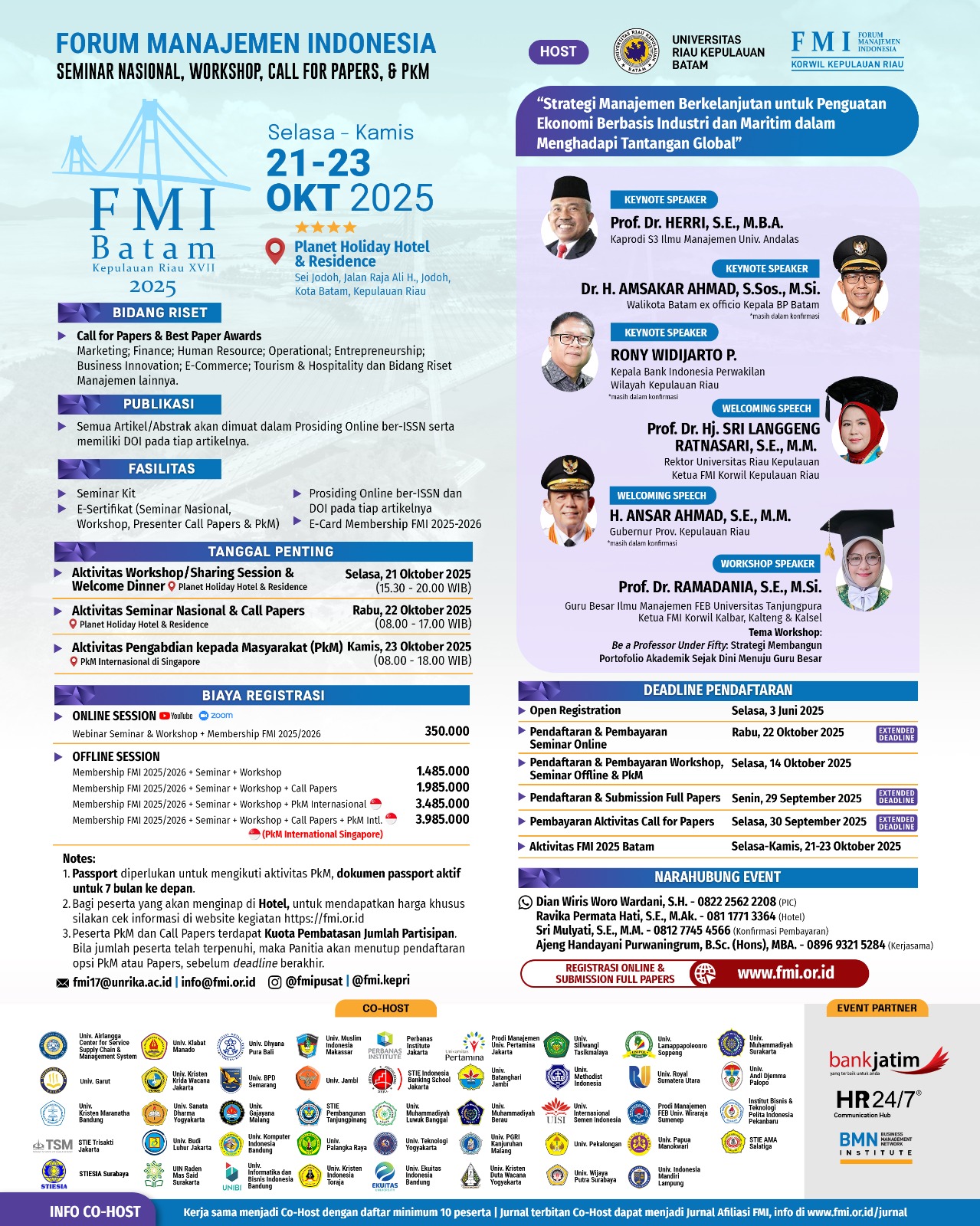
Smart Maritime Management 5.0: Integrating Technology and Humanization in Economic Transformation
DOI:
https://doi.org/10.47747/snfmi.v3i1.3136Abstract
Smart Maritime Management 5.0 is a maritime management concept that integrates advanced technology with humanization values to drive sustainable economic transformation. This approach leverages cutting-edge technologies such as the Internet of Things (IoT), artificial intelligence (AI), big data analytics, and automation systems to enhance operational efficiency, navigation safety, and optimal maritime resource management. On the other hand, humanization focuses on strengthening the human role through competency development, welfare improvement, and active participation in strategic decision-making. The integration of technology and humanization not only enhances the competitiveness of the maritime industry but also fosters an adaptive, inclusive, and socially-oriented ecosystem. This study aims to analyze the implementation model of Smart Maritime Management 5.0 and its impact on economic transformation, with a case study in Indonesia’s maritime sector.
References
Bjerkan, K. Y., & Seter, H. (2022). The digital transformation of the maritime sector. Maritime Policy & Management, 49(5), 653–668. https://doi.org/10.1080/03088839.2021.1899432
Javaid, M., Haleem, A., Singh, R. P., & Suman, R. (2021). Industrial Revolution 5.0: Human–AI collaboration in industry. Sustainable Operations and Computers, 2, 122–132. https://doi.org/10.1016/j.susoc.2021.06.001
Stopford, M. (2020). Maritime Economics (4th ed.). Routledge.
UNCTAD. (2023). Review of Maritime Transport 2023. United Nations Conference on Trade and Development. https://unctad.org
Xu, M., & Yip, T. L. (2021). Smart port digital twin technology. Ocean & Coastal Management, 219, 106003. https://doi.org/10.1016/j.ocecoaman.2021.106003
Christodoulou, A., & Cullinane, K. (2020). Developing port sustainability: A multi-stakeholder perspective. Maritime Policy & Management, 47(7), 877–901. https://doi.org/10.1080/03088839.2020.1713189
International Maritime Organization. (2023). Maritime Autonomous Surface Ships: Regulatory Scoping Exercise. IMO Publications.
Ministry of Transportation of the Republic of Indonesia. (2024). Pelabuhan Pintar dan Digitalisasi Logistik Nasional. Jakarta: Kementerian Perhubungan.
Tseng, P. H., & Pilcher, N. (2022). Maritime 5.0: Integrating technology and human capital for sustainable shipping. Journal of Marine Science and Engineering, 10(6), 789. https://doi.org/10.3390/jmse10060789
United Nations Conference on Trade and Development (UNCTAD). (2023). Review of Maritime Transport 2023. Geneva: UNCTAD.
European Commission. (2021). Industry 5.0: Towards a sustainable, human-centric and resilient European industry. Brussels: European Union Publications.
Ministry of Transportation of the Republic of Indonesia. (2023). Indonesia Maritime Outlook 2023. Jakarta: Kemenhub.
World Bank. (2022). Logistics Performance Index Report. Washington, DC: World Bank Group.
Pradana, Y., & Hidayat, R. (2022). Integrasi teknologi informasi dalam efisiensi pelabuhan Indonesia. Jurnal Transportasi dan Logistik, 14(2), 85–97.
Ryu, H., & Lee, J. (2021). Human-centric smart port management in the Industry 5.0 era. Maritime Policy & Management, 48(7), 945–961.
Setiawan, A., & Susanti, D. (2024). Teknologi dan humanisasi dalam industri maritim Indonesia. Jurnal Ekonomi Maritim, 5(1), 1–15.
Fukuda, Keidanren. “Society 5.0: Human-Centered Future Society.” Hitachi Review, Vol. 66, No. 6, 2017.
International Maritime Organization (IMO). International Shipping Facts and Figures. London: IMO, 2020.
OECD. The Ocean Economy in 2030. Paris: OECD Publishing, 2016.
Schwab, Klaus. The Fourth Industrial Revolution. Geneva: World Economic Forum, 2016.
Stopford, Martin. Maritime Economics. 3rd ed. London: Routledge, 2009.
UNCTAD. Review of Maritime Transport 2021. Geneva: United Nations, 2021.